4. Semiosis
We now analyze graphic design as a message with a meaning.
4.1 Visual Rhetoric: How are the signs used to mean something?
We analyze graphic design as such a composition of signs. A sign here is a visual or symbolic representation that conveys information. A sign [...] is something which stands to somebody for something.
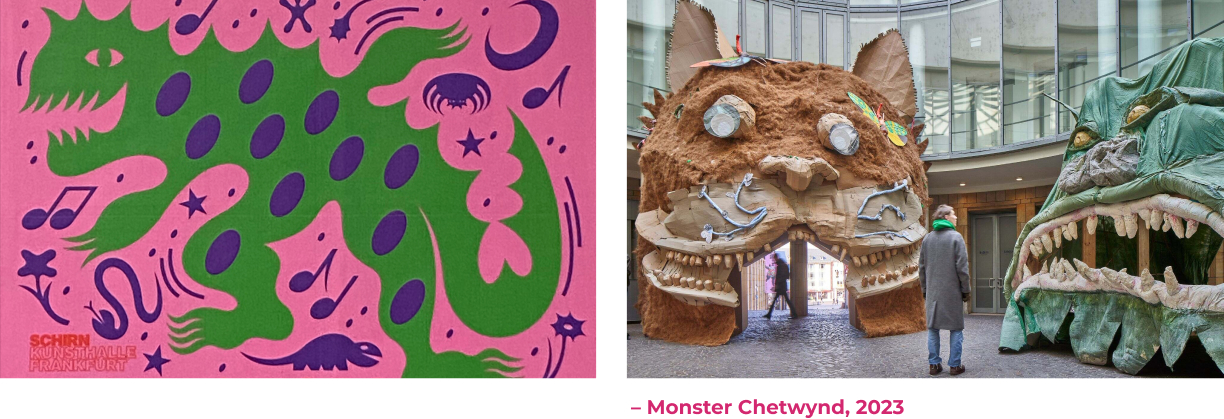
It seems to me that the most striking sign that conveys the most important message here is a character who is in the dance movement. From the figure of the character, the viewer can read the message “dance".
The character itself refers to the exhibition at the Schirn Gallery, to which the event is timed: Monster Chetwynd - A cat is not a dog. At the exhibition, the artist presents her sculptures of monster heads, and a workshop for children on creating papier-mache monsters is also held there.
Other sighns:

Another obvious sign that immediately catches the eye is the notes. They make the poster “musical“ and ”loud", transmitting a message about the sound of music.

There are also many flowers on the poster. Maybe because children are the flowers of life? (I am not sure that this proverb exists in English. But people told me this during my whole life). Children dance around a dinosaur… Well, or it's just a dinosaur on the field.

The moon and stars illustrate the event: children's night at the museum (children's night, lasting until 20:00 :)) And the snake and the acari, as it seems to me, are a kind of "monsters" of our world, again illustrate the Monster Chetwynd's exhibition. Personally, I'm a little confused by this crescent moon, which reminds me of Arabic.
4.2 Multimodality: How do the signs work/play together?
I think the signs here are all working together to create a common disco sign. Creatures dance (a dinosaur, a snake around it, an acari (?), a lizard) to music (movement, notes) in the forest or in the field (flowers, stars, etc).